blogs
Home | Blogs | Cbse Curriculum Changes 2026 27 Parents Guide School Admissions
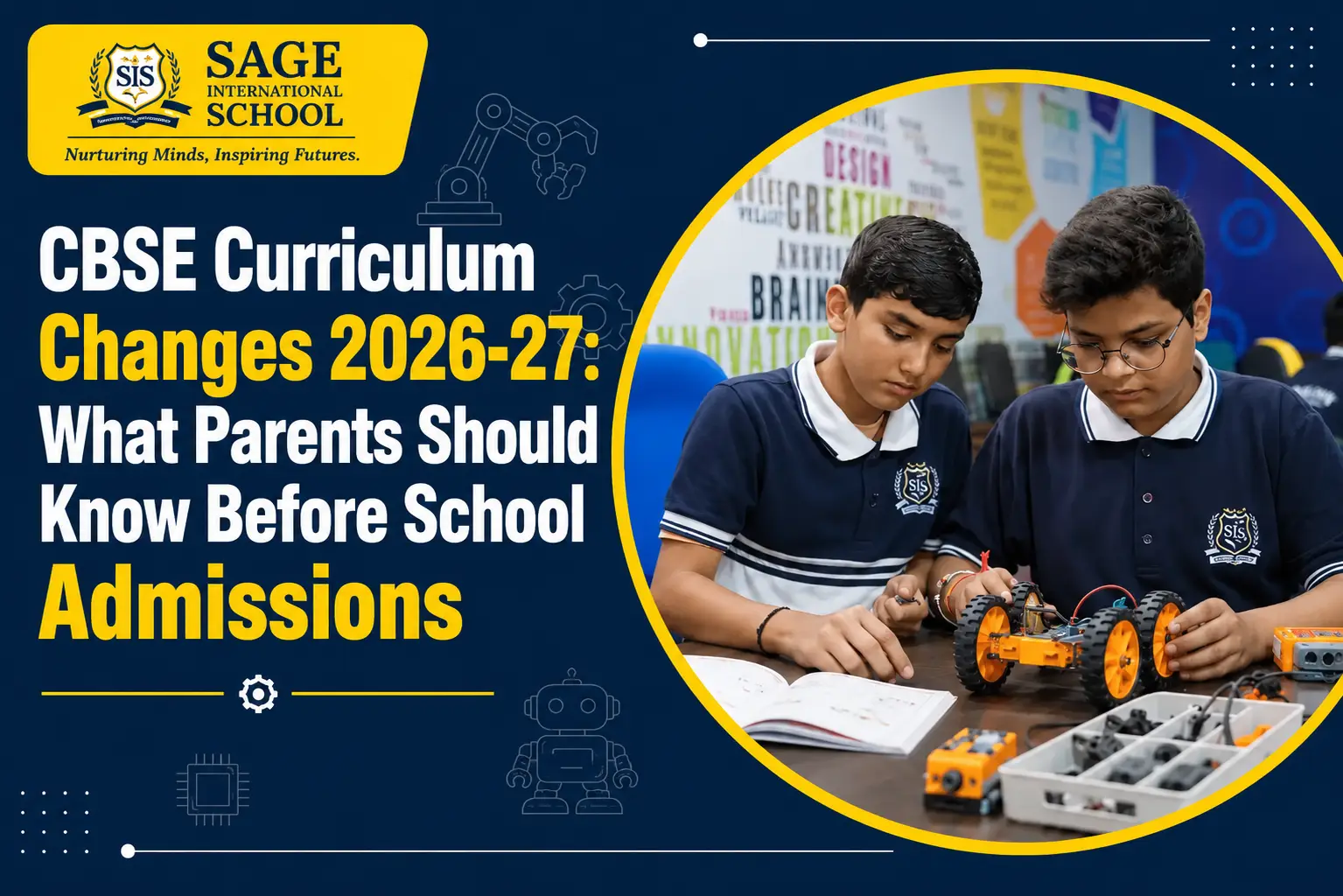
The CBSE curriculum for the 2026–27 academic session introduces important changes, particularly for Class IX students. The revised framework places greater emphasis on conceptual understanding, problem-solving, practical learning, vocational education, and computational thinking.
For parents, understanding these changes is important because they influence how students learn, develop skills, and prepare for future academic opportunities.
In this guide, we explain the major CBSE curriculum changes for 2026–27, what they mean for students and parents, and how families can support the transition.
The major changes include a revised Class IX curriculum, Mathematics and Science options at different levels, Vocational Education (Kaushal Vikas), Individuals in Society, and Computational Thinking and Artificial Intelligence (CT & AI) modules.
The revised curriculum aligns with the National Education Policy (NEP) 2020 and the National Curriculum Framework for School Education (NCF-SE) 2023.
Key updates include:
Parents should consult the latest CBSE curriculum and their school for subject availability, assessment arrangements, and implementation details.
Class IX students will follow a revised scheme of studies that includes academic subjects, vocational education, interdisciplinary learning, and computational thinking modules.
The scheme includes:
The revised approach aims to develop skills beyond memorising textbook information. Students can be encouraged to explain their reasoning, connect concepts with real-life situations, participate in projects, and explore practical applications.
For example, instead of only learning a mathematical formula, students may be asked to apply it to a real-world problem. This helps them understand not only how a concept works but also when and why it is useful.
CBSE's language framework specifies language requirements according to the applicable class and curriculum provisions. The exact language combinations, levels, and implementation arrangements should be checked in the relevant official scheme of studies.
Parents should not assume that every language combination or requirement applies identically across all classes and academic sessions.
For Class IX in 2026–27, the official scheme identifies compulsory languages at R1/R2 levels and lists Language 3 as optional under the stated transitional arrangement.
To understand which languages a student can select, parents should consult the school's subject options and the official CBSE Curriculum 2026–27.
Computational Thinking and Artificial Intelligence are becoming important components of school education because they help students develop logical reasoning, problem-solving, pattern recognition, and an understanding of technology.
For 2026–27, CBSE has introduced a CT & AI curriculum framework for Classes III–VIII. For secondary classes, the applicable arrangements differ by grade and academic session.
Students can develop these skills through activities such as:
CBSE's 2026–27 scheme specifies compulsory CT & AI modules for Classes IX–X, with school-based assessment. The implementation differs by class: the framework identifies CT & AI as a compulsory subject from the 2027–28 session, while the 2026–27 arrangements include modules and transitional provisions. Students and parents should check the applicable requirements with their school.
CBSE introduced a two-board-examination system for Class X from the 2026 examinations. Under the published scheme, appearing in the first examination is mandatory, while eligible students may improve their performance in the second examination under prescribed conditions.
The main provisions include:
CBSE's curriculum direction places increasing emphasis on understanding, application, reasoning, and problem-solving rather than relying exclusively on memorisation.
Competency-based learning asks students to use what they know to solve problems, interpret information, explain their reasoning, and connect classroom concepts with real-life situations.
| Traditional Learning Emphasis | Competency-Based Learning Emphasis |
|---|---|
| Memorising information | Understanding concepts |
| Reproducing learned answers | Applying knowledge |
| Learning concepts in isolation | Connecting ideas with real situations |
| Following a memorised method | Developing reasoning and problem-solving |
| Focusing mainly on marks | Building knowledge and skills |
| Passive learning | Participation, projects, and activities |
Holistic Progress Cards are intended to provide a broader picture of a student's development beyond academic marks alone.
Depending on the applicable framework and school implementation, progress information may include learning outcomes, participation in activities, projects, self-assessment, and other aspects of student development.
Kaushal Vikas refers to Vocational Education included in the Class IX scheme of studies for 2026–27. Vocational education introduces students to practical, skill-oriented learning and helps them explore different interests and capabilities.
Parents can help students adapt to curriculum changes by building consistent learning habits and encouraging curiosity.
One of the major changes is the revised Class IX curriculum aligned with NCF-SE 2023, which includes Mathematics and Science options at different levels, Vocational Education, Individuals in Society, and CT & AI modules.
Yes. CBSE has published a revised Class IX curriculum for 2026–27. Students and parents should consult official curriculum documents and their school for details.
For 2026–27, CBSE specifies compulsory CT & AI modules for Classes IX–X with school-based assessment. It becomes a full compulsory subject starting in the 2027–28 session.
Yes, introduced from the 2026 cycle. The first examination is mandatory, while eligible students may use the second examination to improve their performance.
The CBSE 2026-27 curriculum reflects a broader emphasis on conceptual understanding, practical skills, interdisciplinary learning, and computational thinking. Parents can support this transition by encouraging curiosity, independent thinking, consistent study habits, and meaningful learning experiences. For official updates, always consult with your school and official CBSE portals.