blogs
Home | Blogs | Science Facts For Kids
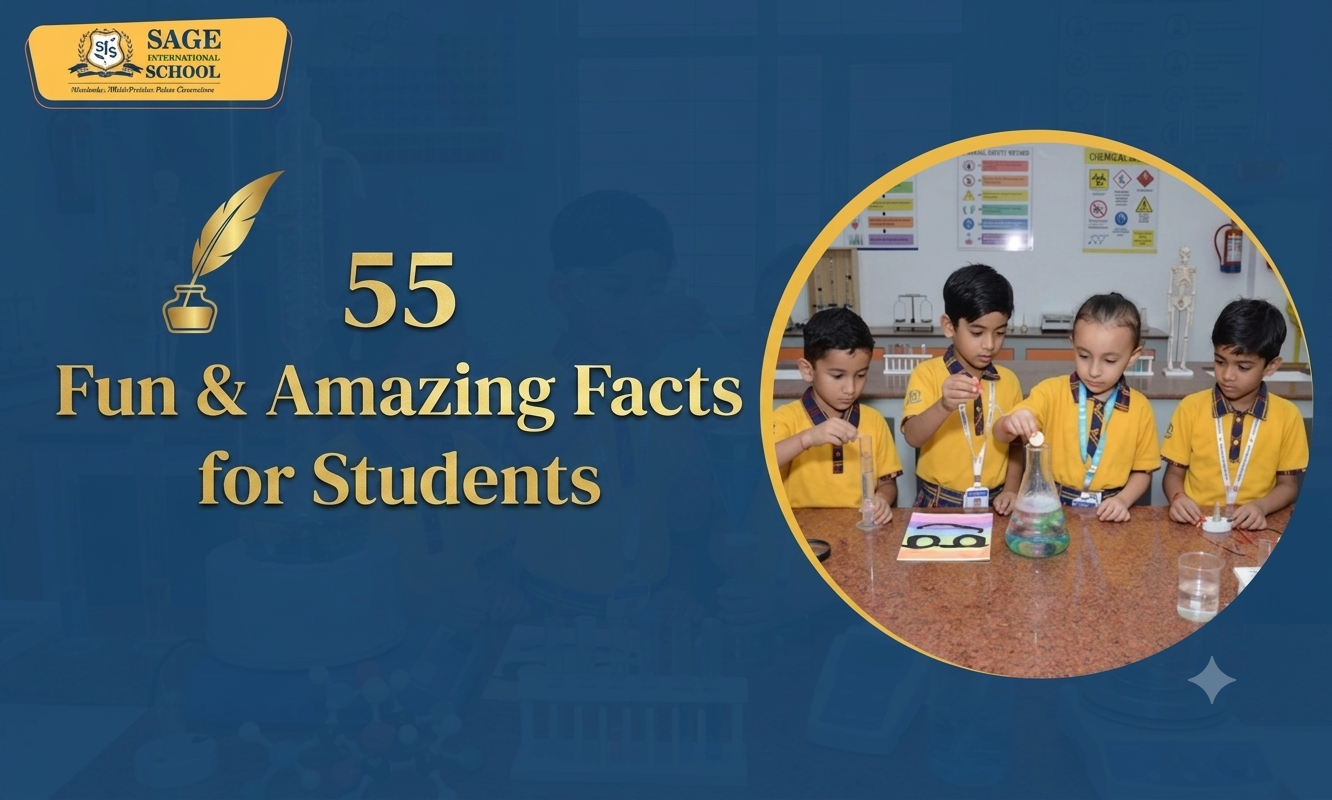
Science is everywhere — from the stars in the sky to the smartphone in your pocket. This guide brings together 55 fun and amazing science facts for kids and students that make learning exciting and memorable. Whether you are preparing for a school project, a quiz, or simply a curious young mind eager to explore, this 2026 edition covers the most fascinating discoveries across space, the human body, animals, chemistry, physics, and more. Each fact is explained with context so you understand not just what is true, but why it matters. Perfect for students in Class 1 through Class 10.
Science builds the skills that shape every career and every life decision. When students engage with science, they develop
Curiosity — the habit of asking 'why?' and 'how?'
These skills prepare students for careers in medicine, engineering, technology, environmental science, and research — as well as everyday decisions about health, finance, and the world around them.
Class 4-10 | Space & Astronomy
1. The Sun could swallow 1.3 million Earths.
The Sun has a diameter of approximately 1.39 million kilometres — about 109 times wider than Earth. Because volume scales with the cube of the radius, you could fit roughly 1.3 million Earths inside the Sun. Despite its size, the Sun is considered a medium-sized star compared to giants like VY Canis Majoris. (Source: NASA)
2. A day on Venus is longer than its year.
Venus rotates so slowly on its axis that one Venusian day lasts 243 Earth days. Yet Venus completes a full orbit around the Sun in just 225 Earth days — making its year shorter than its own day. Venus also rotates in reverse compared to most planets, so the Sun rises in the west there. (Source: NASA Solar System Exploration)
3. Jupiter is the largest planet in our Solar System.
Jupiter's diameter is 142,984 kilometres — more than 11 times Earth's diameter. Its mass is 2.5 times greater than all other planets combined. Jupiter's famous Great Red Spot is a storm that has been raging for over 350 years and is larger than Earth itself.
4. Saturn's rings are made of ice and rock — and they are disappearing.
Saturn's iconic rings are composed mainly of ice particles, rocky debris, and dust ranging from tiny grains to chunks as large as a house. NASA scientists discovered that Saturn is losing its rings at a rate that could cause them to vanish within 100 million years — relatively soon on an astronomical timescale.
5. The Milky Way contains an estimated 200–400 billion stars.
Our galaxy, the Milky Way, is a barred spiral galaxy roughly 100,000 light-years across. Scientists estimate it holds between 200 and 400 billion stars, yet we can only see about 9,000 of them with the naked eye from Earth. The nearest star to our Sun is Proxima Centauri, about 4.24 light-years away. (Source: NASA)
6. The Moon has no atmosphere — so it has no weather.
Unlike Earth, the Moon has virtually no atmosphere, which means there is no wind, no rain, and no weather of any kind. Footprints left by Apollo astronauts in 1969 are still perfectly preserved on the lunar surface today and could remain there for millions of years.
7. Astronauts grow slightly taller in space.
In microgravity, the spine is no longer compressed by Earth's gravitational pull. Spinal discs expand and astronauts can grow 2–5 centimetres taller during long missions. This growth reverses within a few days of returning to Earth as gravity compresses the spine back to normal.
Class 3-8 | Biology & Health
1. Your brain has around 86 billion neurons.
Neurons are specialised nerve cells that transmit information throughout the brain and body using electrical and chemical signals. With 86 billion neurons and trillions of synaptic connections between them, the human brain is the most complex structure known in the universe. It processes information at speeds of up to 120 metres per second. (Source: NIH)
2. The heart beats about 100,000 times every day.
A healthy adult heart beats 60–100 times per minute, adding up to over 100,000 beats per day and more than 2.5 billion beats in a lifetime. The heart pumps approximately 7,000 litres of blood every day — enough to fill around 35 bathtubs. (Source: American Heart Association)
3. Skin is the body's largest organ.
The average adult's skin covers an area of about 1.7–2 square metres and weighs between 3.5 and 10 kilograms — making it the largest organ in the human body by surface area. Skin has three main layers: the epidermis (outer), dermis (middle), and hypodermis (inner), each with distinct protective and sensory functions.
4. Bones are stronger than concrete by weight.
Bone is a remarkable composite material made of collagen fibres reinforced with calcium phosphate crystals. Gram for gram, cortical bone is stronger than steel and four times stronger than concrete. Despite this strength, the human skeleton is lightweight — accounting for only about 15% of body weight.
5. Humans blink approximately 15–20 times per minute.
Each blink lasts about 150–400 milliseconds and spreads a thin film of tears across the cornea, keeping eyes moist, clean, and protected from dust. Blinking is so fast and automatic that most people are unaware they are doing it. We blink less when reading or using screens — which is why eyes feel dry with extended screen time.
6. The stomach replaces its lining every 3–5 days.
The stomach produces strong hydrochloric acid (pH 1.5–3.5) to break down food. To protect itself from this acid, the stomach generates a new mucosal lining approximately every three to five days. Without this constant renewal, the stomach would begin to digest itself.
14. Babies are born with around 270–300 bones; adults have 206.
Infants have more bones than adults because many bones are still separated and made partly of cartilage to allow for the flexibility needed during birth. As children grow, bones gradually fuse together through a process called ossification, completing around the age of 25. The last bones to fuse are typically in the skull and pelvis.
Class 1-6 | Zoology & Wildlife
1. Octopuses have three hearts and blue blood.
Two branchial hearts pump blood through the gills, while a third systemic heart circulates oxygenated blood to the rest of the body. Octopus blood is blue because it contains haemocyanin — a copper-based oxygen carrier — instead of the iron-based haemoglobin that makes human blood red. Haemocyanin works more efficiently at low temperatures, which suits the cold ocean environments where octopuses live. (Source: WWF)
2. Giraffes have exactly seven neck vertebrae — the same as humans.
Despite having necks up to 1.8 metres long, giraffes have the same number of cervical (neck) vertebrae as humans: seven. The difference is that each giraffe vertebra can be over 25 centimetres long, compared to just a few centimetres in humans. The long neck helps giraffes reach leaves high in acacia trees that other animals cannot access.
3. Dolphins sleep with one eye open.
Dolphins practise unihemispheric slow-wave sleep — resting one half of their brain at a time while the other half remains alert. This allows them to keep one eye open to watch for predators and continue surfacing to breathe while sleeping. Bottlenose dolphins in this state are often seen floating near the surface in a behaviour called 'logging.'
4. Penguins are expert swimmers but cannot fly.
Penguins' wings evolved over millions of years into stiff, paddle-like flippers perfectly shaped for swimming rather than flight. Emperor penguins can dive to depths of over 500 metres and hold their breath for more than 20 minutes while hunting fish and squid under Antarctic ice. (Source: WWF)
5. Honeybees communicate through dance.
When a worker bee discovers a food source, she returns to the hive and performs a 'waggle dance' — a figure-eight movement that communicates the direction, distance, and quality of the food relative to the sun. This remarkable form of non-verbal communication was decoded by Austrian scientist Karl von Frisch, who won the Nobel Prize in Physiology in 1973 for this discovery.
6. Some snails can hibernate for up to three years.
During periods of extreme drought or cold, land snails can seal themselves inside their shells with a layer of dried mucus called an epiphragm and enter a state of deep dormancy. During this time, their metabolism slows to near-zero. In warm, humid conditions, they rehydrate and resume normal activity.
7. Cheetahs are the fastest land animals, reaching 112 km/h.
A cheetah can accelerate from 0 to 100 km/h in just 3 seconds — faster than most sports cars. At full sprint they can reach 112 km/h (70 mph). However, they can only sustain this speed for about 30 seconds before overheating. After a chase, cheetahs must rest for 15–30 minutes before they can eat their prey.
Class 3-8 | Earth Science & Geography
1. 71% of Earth is covered by water, yet 97% is salty.
Of all the water on Earth, only about 3% is fresh water — and of that, approximately 68% is locked in glaciers and ice caps. Just 0.3% of Earth's total water is accessible as fresh surface water in rivers and lakes. This makes fresh water one of our most precious and finite natural resources. (Source: USGS)
2. A lightning bolt is five times hotter than the Sun's surface.
The surface of the Sun reaches approximately 5,500°C. A single bolt of lightning, however, superheats the surrounding air to around 30,000°C — five times hotter than the solar surface. This extreme heat causes the rapid expansion of air that produces the sound of thunder.
3. Rainbows always appear in the direction opposite the Sun.
A rainbow forms when sunlight enters water droplets in the air, refracts, reflects off the inside of the droplet, and exits at an angle — separating white light into its spectrum of colours. Because of the geometry of this process, a rainbow always appears in the sky directly opposite the Sun from the observer's perspective.
4.Volcanoes create new land.
When lava from volcanic eruptions cools and solidifies, it forms new rock — literally building new land. The Hawaiian Islands were entirely created by underwater volcanic activity over millions of years. Today, the Big Island of Hawaii continues to grow as lava from Kilauea flows into the ocean and hardens into new basalt rock.
26. Earth is the only planet known to support life.
Earth sits in the 'Goldilocks Zone' — the habitable region around the Sun where temperatures are just right for liquid water to exist. It also has a protective magnetic field, a stable atmosphere with 21% oxygen, and plate tectonics that recycle nutrients. No other planet has yet been confirmed to host life, though the search continues.
27. Coral reefs cover less than 1% of the ocean but support 25% of all marine species.
Often called the 'rainforests of the sea,' coral reefs provide habitat, feeding grounds, and nurseries for an estimated 25% of all marine life despite covering less than 1% of the ocean floor. They also protect coastlines from wave erosion and support fishing industries that feed over one billion people. (Source: NOAA)
Class 6-10 | Technology & Innovation
1. AI helps doctors detect diseases earlier than ever before.
Artificial intelligence systems can analyse medical scans — such as MRI images and X-rays — to identify early signs of cancer, diabetic retinopathy, and other conditions with accuracy that matches or surpasses experienced specialists. In 2026, AI-assisted diagnostics are used in hospitals across the world to reduce missed diagnoses and improve patient outcomes. (Source: WHO, 2025)
2. Robots assist in surgeries, warehouses, and hospitals.
Robotic surgical systems like the da Vinci Surgical System allow surgeons to perform minimally invasive procedures with greater precision than the human hand alone. In warehouses, robots can sort and move thousands of packages per hour. Hospital robots now deliver medications, clean wards, and assist elderly patients with mobility.
3. Self-driving cars use radar, lidar, cameras, and AI together.
Autonomous vehicles continuously process data from multiple sensors: radar measures distance and speed, lidar creates a 3D map of surroundings, cameras read signs and lanes, and AI interprets everything in real time to make split-second driving decisions. By 2026, limited self-driving vehicles operate commercially in multiple countries.
4. Smartphones use AI to recognise your face in milliseconds.
Facial recognition on modern smartphones works by mapping thousands of distinct points on your face using infrared sensors and then comparing the result to a stored mathematical model. This process takes less than one second. The data is stored locally on the device rather than in the cloud for security.
5. Scientists use AI to discover new medicines up to ten times faster.
Traditional drug discovery can take 10–15 years. AI models can now analyse molecular structures and predict which chemical compounds are most likely to be effective against a disease, dramatically shortening the research phase. AlphaFold, developed by Google DeepMind, predicted the 3D structure of nearly every known protein — a breakthrough that accelerated medicine research worldwide.
Class 5-10 | Physics
1. Sound cannot travel in space — it is completely silent.
Sound is a mechanical wave that requires a medium (such as air, water, or solid material) to travel through. In the vacuum of space, there is no medium, so sound cannot propagate. The dramatic explosions you hear in science fiction space films are creative licence — in reality, space is completely silent. Light, however, is an electromagnetic wave and travels perfectly well through a vacuum.
2. Gravity keeps planets in orbit around stars.
Gravity is a force of attraction between all objects with mass. The Sun's enormous mass creates a gravitational pull that keeps the planets of the Solar System in elliptical orbits. Without gravity, the planets would fly off into space in straight lines. Gravity also keeps the Moon orbiting Earth and causes the ocean tides.
3. Light travels at approximately 299,792 km per second.
The speed of light in a vacuum is 299,792,458 metres per second — approximately 300,000 km/s. Light from the Sun takes about 8 minutes and 20 seconds to reach Earth. Light from the nearest star beyond our Sun (Proxima Centauri) takes 4.24 years to reach us — which is why distances in space are measured in 'light-years.' (Source: NIST)
4. Every magnet has a north and south pole — you cannot separate them.
All magnets, from a small fridge magnet to Earth's core, have two inseparable poles: north and south. If you cut a magnet in half, you do not get separate north and south poles — you get two smaller magnets, each with its own north and south pole. This property is described by the scientific principle that magnetic monopoles do not exist in nature.
Class 5-10 | Chemistry
1. Water is the only substance that naturally exists in all three states.
Water is made of two hydrogen atoms and one oxygen atom (H₂O). Uniquely, water naturally exists on Earth as a solid (ice), liquid (water), and gas (water vapour) within the normal range of temperatures found on our planet's surface. This versatility makes water essential for life as we know it.
2. Diamonds and pencil graphite are both made of pure carbon.
Carbon is one of the most versatile elements. When carbon atoms arrange themselves in a rigid tetrahedral lattice, they form diamonds — the hardest natural material on Earth. When the same carbon atoms stack in flat hexagonal layers, they form graphite — one of the softest materials, used in pencil 'lead.' The difference is entirely in atomic arrangement. (Source: Royal Society of Chemistry)
3. Rust is the result of a chemical reaction between iron, oxygen, and water.
Rust (iron oxide, Fe₂O₃) forms when iron or steel is exposed to both oxygen and moisture over time. This electrochemical reaction is called oxidation. Rust weakens metal structures over time, which is why bridges, ships, and buildings use protective coatings, paints, or stainless steel alloys to prevent it.
4. Baking soda and vinegar produce carbon dioxide gas.
When sodium bicarbonate (baking soda) reacts with acetic acid (vinegar), it produces carbon dioxide (CO₂) gas, water, and sodium acetate. This rapid release of CO₂ gas causes the familiar fizzing and foaming seen in science fair volcano demonstrations. The same reaction is used in baking to make cakes and bread rise.
Class 1-7 | Botany & Nature
1. Plants make their food through photosynthesis using sunlight.
Photosynthesis is the process by which plants convert carbon dioxide from the air, water from the soil, and energy from sunlight into glucose (food) and oxygen. The chemical equation is: 6CO₂ + 6H₂O + light energy → C₆H₁₂O₆ + 6O₂. Every breath of oxygen we take was produced by this process. (Source: Royal Botanic Gardens, Kew)
2. Bamboo is the fastest-growing plant on Earth.
Some species of bamboo can grow up to 91 centimetres (nearly one metre) in a single day under ideal conditions. Bamboo is technically a grass, not a tree, and its hollow, segmented structure makes it stronger than steel by weight — which is why it is widely used as a building material in many parts of Asia and Africa.
3. Sunflowers track the Sun — but only when they are young.
Young sunflowers exhibit heliotropism — they track the Sun's movement from east to west during the day and then reset overnight. Scientists discovered this is driven by faster growth on one side of the stem. Mature sunflowers, however, stop tracking and permanently face east, which warms them in the morning and attracts more pollinators. (Source: UC Davis research, 2016)
4. Trees communicate and share nutrients through underground fungal networks.
Mycorrhizal fungi form a vast underground network — sometimes called the 'Wood Wide Web' — connecting the root systems of trees in a forest. Through this network, trees exchange nutrients (carbon, nitrogen, phosphorus) and chemical signals. Mature 'mother trees' have been shown to direct extra nutrients to younger seedlings of the same species through these connections. (Source: Suzanne Simard, University of British Columbia)
Class 1-10 | Mind-Blowing Science
5. Bananas are mildly radioactive.
Bananas contain potassium, and a small fraction of all potassium is the radioactive isotope potassium-40 (K-40). This gives bananas a tiny, completely harmless dose of natural radioactivity. Scientists even have a unit of measurement called the 'Banana Equivalent Dose (BED)' to compare low-level radiation. You would need to eat about 10 million bananas at once to receive a dangerous dose. (Source: US Nuclear Regulatory Commission)
6. Hot water can freeze faster than cold water — the Mpemba Effect.
Under certain conditions, hot water freezes faster than cold water — a phenomenon known as the Mpemba Effect, named after Tanzanian student Erasto Mpemba who observed it in 1963 while making ice cream. While scientists have reproduced the effect in experiments, the full explanation remains an active area of research, with theories involving dissolved gases, evaporation, and convection currents.
7. There are more stars in the universe than grains of sand on all Earth's beaches.
Scientists estimate the observable universe contains approximately 2 trillion galaxies, each with hundreds of billions of stars. The total number of stars — estimated at around 10²⁴ (one septillion) — dwarfs the estimated 7.5 × 10¹⁸ grains of sand on all of Earth's beaches and deserts. (Source: European Space Agency)
8. Ice floats because it is less dense than liquid water.
Most substances become denser when they solidify — but water is a rare exception. As water freezes, its molecules arrange into a hexagonal crystal lattice that is actually less dense than liquid water. This is why ice floats. This property is critical for life: floating ice insulates the water below, allowing aquatic life to survive through cold winters. (Source: USGS)
9. Only about 3% of Earth's water is fresh water — and most is frozen.
Of Earth's approximately 1.386 billion km³ of water, around 97% is salt water in the oceans. Of the 3% that is fresh water, roughly 68% is locked in glaciers and polar ice, 30% is underground, and less than 1% is in surface rivers, lakes, and reservoirs accessible for human use. (Source: USGS)
1. The brain consumes about 20% of the body's total energy.
The human brain accounts for only 2% of body weight but uses approximately 20% of all the energy (glucose and oxygen) the body produces. Neurons require constant energy to maintain electrical gradients and transmit signals. This is why mental tasks feel tiring, and why good nutrition directly supports better concentration and memory. (Source: NIH)
2. Sleep is essential for memory consolidation.
During sleep — particularly during the slow-wave and REM (Rapid Eye Movement) stages — the brain replays and consolidates information learned during the day, transferring it from short-term to long-term memory storage. Research shows that students who sleep 8–9 hours after studying retain 20–40% more information than those who stay up late. (Source: Harvard Medical School Sleep Research)
1. Soap removes germs by surrounding and breaking down oil and fat.
Soap molecules have two ends: one that is attracted to water (hydrophilic) and one that is attracted to oil (hydrophobic). The oil-loving end attaches to grease and the outer membrane of bacteria and viruses; the water-loving end allows the whole complex to be rinsed away with water. This mechanical action physically removes pathogens rather than killing them chemically.
2. Mirrors reflect light because of a thin layer of metal.
A mirror is made of glass coated on the back with a thin layer of silver, aluminium, or chrome. These metals reflect almost all visible light that strikes them (up to 99%), allowing you to see a clear, accurate reflection. The glass protects the metal coating from tarnishing. Mirrors work because reflected light travels back to your eyes at the same angle it hit the surface.
3. Pressure cookers cook food faster because of increased steam pressure.
Inside a pressure cooker, steam cannot escape, which raises the internal pressure. Higher pressure raises the boiling point of water above 100°C to around 120°C. This higher temperature cooks food significantly faster — often in one-third the time of conventional cooking — while also requiring less energy.
4. Mobile phones communicate using radio waves travelling at the speed of light.
When you make a call or send a message, your phone converts your voice or data into a radio wave signal and transmits it to the nearest cell tower. The signal travels as an electromagnetic wave — the same family as light — at 299,792 km/s. The tower routes the signal through a network until it reaches the recipient's phone, all in fractions of a second.

Fresh for 2026 | Latest Science News
Science never stops — here are some of the most exciting developments happening in 2026 that students should know about:
These comparisons help make abstract scientific scales easier to understand:
Use these groupings to quickly find facts appropriate for each level:
Class 1–3 (Basic — Simple & Visual Facts)
Facts 15, 18, 19, 21, 27, 37, 41, 43, 52, 53 — covering animals, plants, and everyday science.
Class 4–6 (Intermediate — Explanatory Facts)
Facts 1–7, 10–14, 16, 17, 20, 22–26, 42, 44–49, 54, 55 — covering space, earth science, body, and chemistry basics.
Class 7–10 (Advanced — Scientific Depth)
Facts 8, 9, 28–36, 38–40, 50, 51 — covering AI, physics, advanced biology, chemistry, and brain science.
Test your knowledge! Try these questions before looking at the answers.
Q: Which planet has the most famous rings?
Answer: Saturn — its rings are made of ice and rock and could vanish within 100 million years.
Q: Which organ pumps blood around the body?
Answer: The heart — it beats approximately 100,000 times every day and pumps around 7,000 litres of blood.
Q: Which gas do plants absorb to make food?
Answer: Carbon dioxide (CO₂) — through the process of photosynthesis using sunlight and water.
Q: Which planet is the largest in our Solar System?
Answer: Jupiter — its mass is greater than all other planets combined.
Q: Which animal has three hearts and blue blood?
Answer: The octopus — its blood is blue because it contains copper-based haemocyanin.
Q: How many bones do babies have at birth?
Answer: Around 270–300 bones, which gradually fuse to 206 bones in adulthood.
Q: What do we call the process by which trees share nutrients underground?
Answer: The mycorrhizal network — sometimes called the 'Wood Wide Web.'
Q: Why does ice float on water?
Answer: Because ice is less dense than liquid water — its molecules form a spacious hexagonal crystal structure when frozen.
Ques : What are the most amazing science facts for kids?
Ans : Some of the most amazing science facts for kids include: octopuses have three hearts and blue blood, lightning is five times hotter than the Sun's surface, and bamboo can grow nearly one metre in a single day. Facts about the human body — such as the brain having 86 billion neurons — are particularly popular for school projects and quizzes.
Ques : What are easy science facts for Class 1 and Class 2 students?
Ans : Easy science facts for younger children include: sunflowers turn toward the Sun, penguins cannot fly but swim expertly, and the heart beats about 100,000 times a day. These simple, visual facts about animals, plants, and the human body are ideal for Class 1 and Class 2 students and can be turned into fun classroom activities.
Ques : What are good science facts for a school project?
Ans : Good science facts for school projects include topics with visual impact and clear explanations. Facts about space (the Sun fitting 1.3 million Earths), chemistry (diamonds and graphite being the same element), and biology (trees communicating underground) work well for presentations, posters, and science fair projects because they combine surprising information with clear scientific reasoning.
Ques : Why should students learn science facts?
Ans : Learning science facts helps students develop curiosity, critical thinking, and logical reasoning skills. Beyond passing exams, understanding science helps students make informed decisions about health, technology, and the environment. It also opens doors to careers in medicine, engineering, computing, and research — some of the most in-demand professions of the 21st century.
Ques : What are science facts for Class 5 and Class 6 students?
Ans : For Class 5 and Class 6 students, great science facts include: the water cycle and why only 3% of Earth's water is drinkable, how photosynthesis produces the oxygen we breathe, why bones are stronger than concrete, and how self-driving cars use AI and sensors. These facts connect classroom learning to real-world technology and the environment.
Ques : What are the most interesting facts about the human body for students?
Ans : Fascinating human body facts for students include: the brain uses 20% of the body's energy despite being only 2% of its weight, the stomach completely replaces its inner lining every 3–5 days to protect itself from its own acid, and babies are born with up to 300 bones — almost 100 more than adults have. These facts make biology lessons memorable and relevant.
Ques : Are there science facts related to AI and technology for students?
Ans : Yes — in 2026, AI science is highly relevant for school students. Key facts include: AI can detect cancer from medical scans with accuracy matching specialist doctors, AlphaFold predicted the structure of nearly every known protein, and large language models are being used to discover new medicines up to ten times faster than traditional methods. These are excellent topics for Class 8–10 projects.
Ques : What are science facts about water?
Ans : Important science facts about water include: water is the only substance on Earth that naturally exists as a solid, liquid, and gas; ice floats because it is less dense than liquid water (a property that is critical for aquatic life surviving winter); and only about 0.3% of Earth's water is accessible fresh surface water in rivers and lakes — making conservation essential.
Ques : Who can use these science facts?
Ans : These science facts are suitable for all school students from Class 1 to Class 10. They are organised by difficulty level and topic, making them useful for teachers preparing lesson plans, parents supporting homework, students revising for exams, and young learners who are simply curious about the world around them.
Ques : What are some fun chemistry facts for students?
Ans : Fun chemistry facts include: diamonds and pencil graphite are both made of pure carbon (just arranged differently), water is made of two hydrogen atoms and one oxygen atom, and baking soda and vinegar react to produce carbon dioxide gas — the same reaction used to make bread and cakes rise. These facts bring the periodic table to life in everyday contexts.