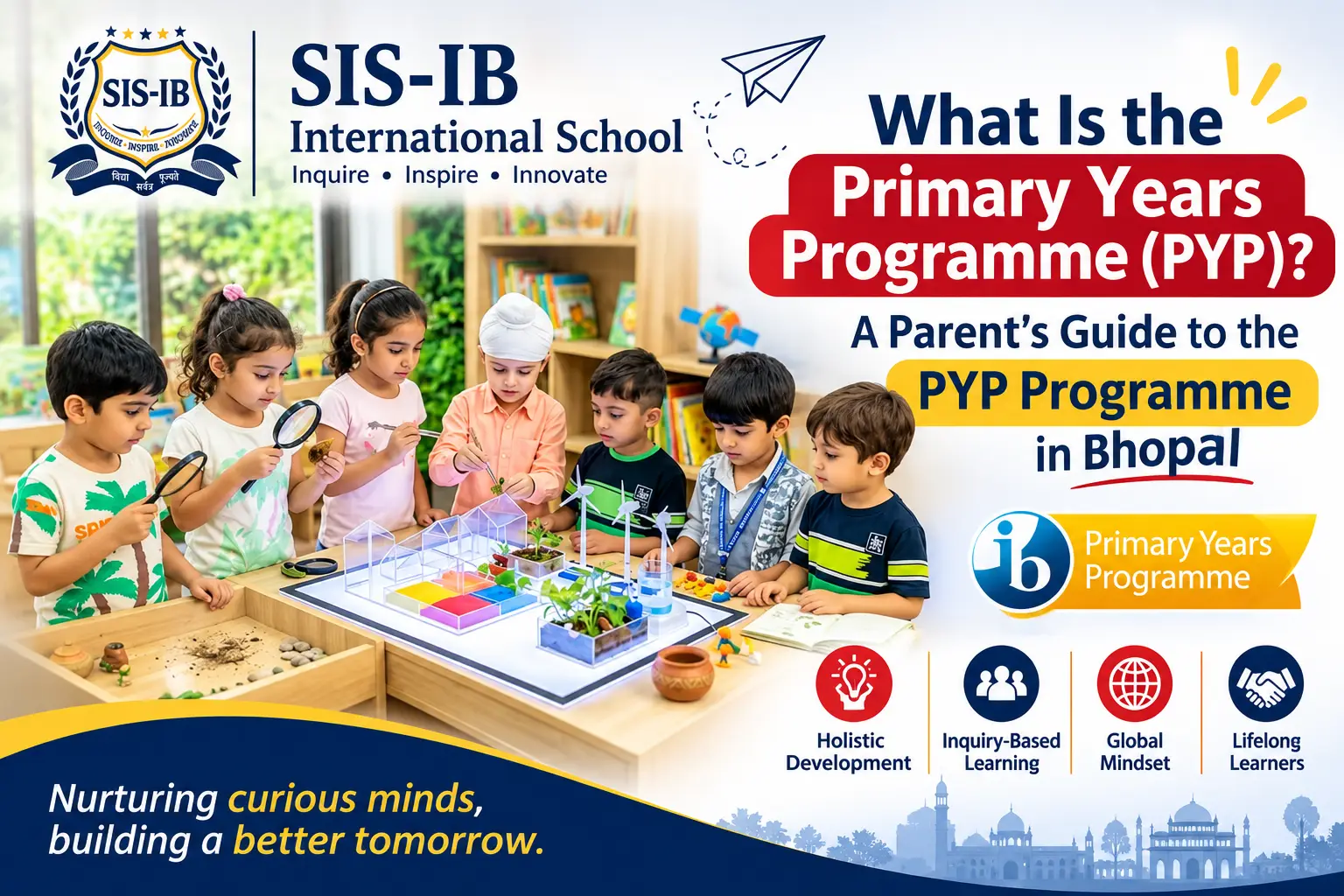
Choosing a school involves more than looking at textbooks and examination results. Parents also want to know whether their children will learn to ask questions, express themselves, work with others and apply what they know. The International Baccalaureate (IB) Primary Years Programme, or PYP, brings these aspects of learning together. The PYP Programme, also known as the IB PYP Programme, focuses on developing these essential skills during a child’s early learning years.
At SAGE International School IB in Bhopal, our Primary Years learning pathway covers PYP 1 to PYP 5. We aim to make learning purposeful through strong academic foundations, inquiry, collaboration and reflection. Parents exploring the PYP Programme in Bhopal can learn more about this learning approach at SAGE International School IB.
If you are exploring international education options for your child, read our guide on why Bhopal needs an IB school to understand the importance of IB education, its learning approach and the growing need for international education in Bhopal.
1. What Is the IB Primary Years Programme (PYP)? What Is the PYP Full Form?
The PYP full form is Primary Years Programme. PYP is the short form used for the International Baccalaureate Primary Years Programme. The PYP is an educational framework developed by the International Baccalaureate for children aged 3 to 12. It places the learner at the centre and encourages conceptual understanding, inquiry and personal growth. Rather than treating learning as the memorisation of separate facts, it helps children see connections between ideas and use their understanding in different situations.
The PYP framework covers the wider 3–12 age range; SAGE’s own enquiry levels are EYP 1–3 and PYP 1–5. The school’s current IB candidacy status is distinct from IB World School authorisation.
2. How Does Inquiry-Based Learning Work in the PYP Programme?
Inquiry begins with curiosity. A question, an object, a story or a real-life situation can encourage students to notice details, share what they already know and investigate further. Teachers provide the necessary explanations, resources and structure while helping students test ideas and reflect on their findings.
For example, an inquiry into how communities change can bring together maps, historical accounts, reading, writing and mathematical reasoning. Children learn subject content while considering a wider question. Direct instruction and regular practice remain important, particularly in language and mathematics.
3. What Subjects Do Children Study in the IB PYP Programme?
The PYP framework recognises six subject areas: language, mathematics, science, social studies, arts, and personal, social and physical education (PSPE). These areas support academic, creative, physical and social development.
At SIS-IB, our Primary Years learning also draws on English, Hindi, French, ICT, visual and performing arts and physical education, as appropriate to the grade. Subject learning is strengthened when children can apply it in meaningful contexts.
4. What Is Transdisciplinary Learning in the PYP Programme?
Transdisciplinary learning means exploring an important idea through more than one subject. The PYP organises inquiry around six broad themes:
- Who We Are
- Where We Are in Place and Time
- How We Express Ourselves
- How the World Works
- How We Organise Ourselves
- Sharing the Planet
A unit on cultural expression, for instance, may involve language, visual art, music, history and discussion. Students learn to appreciate different perspectives while developing specific subject skills. The connections are purposeful; subjects do not lose their individual importance.
5. What Is the IB Learner Profile?
The Learner Profile describes ten attributes that children can practise in school and beyond: inquirers, knowledgeable, thinkers, communicators, principled, open-minded, caring, risk-takers, balanced and reflective. These are not simply labels. A child who listens to a different opinion is practising open-mindedness; one who reviews a first attempt and improves it is being reflective.
6. How Do Approaches to Learning Build Essential Skills in the PYP?
Approaches to Learning (ATL) focus on five skill groups: thinking, research, communication, social and self-management. Children develop these through asking questions, finding information, presenting ideas, working in teams, managing responsibilities and reflecting on their progress. These skills support learning across subjects and become increasingly valuable as students grow.
7. Student Agency and Self-Efficacy in the IB PYP Programme
Student agency means having a voice, making appropriate choices and taking ownership of learning. Teachers may invite children to suggest questions, choose a way to demonstrate understanding or evaluate their own work. Such choices are supported by clear expectations and guidance.
Self-efficacy is the belief that effort, strategies and support can help us meet a challenge. When children set achievable goals, learn from feedback and recognise their progress, they begin to approach unfamiliar tasks with greater confidence.
8. Learning Beyond the Classroom
Learning is enriched by experiences that allow children to practise skills in different settings. At Sage International School - IB, cultural experiences, community engagement, sports, visual and performing arts and skill-development activities complement classroom learning. They give students opportunities to express themselves, collaborate and understand their responsibilities towards others.
Our Skill Builder experiences draw on a London-based skills-development approach. We Speak uses a TED Talks-style presentation format to encourage organised thinking and confident public speaking, while Spell Bee activities strengthen vocabulary, spelling and language confidence. PSPE supports personal wellbeing, relationships and physical development. Together, these experiences help children explore interests and develop balanced habits.
9. How Is Student Progress Assessed in the PYP Programme?
Assessment is an ongoing part of teaching and learning, not only a test at the end of a topic. Teachers use observations, discussions, classroom work, presentations and reflections to understand what a student knows and what support may be needed next.
Monitoring
Following understanding, participation and skill development as learning takes place.
Documenting
Keeping useful evidence of learning through work samples, observations and reflections.
Measuring
Considering learning evidence against goals and appropriate criteria to identify achievement and next steps.
Reporting
Communicating progress to students and families through the school’s approved feedback and reporting processes.
10. Why Might Parents Choose a PYP-Informed Learning Approach?
Parents understandably expect children to read well, write clearly and become confident with mathematics. They also want them to make thoughtful decisions, ask sensible questions and work respectfully with others. An inquiry-led approach seeks to develop these abilities together. Children build knowledge and practise using it, with teachers providing guidance and support suited to their stage of learning.
11. The PYP Programme in Bhopal: Primary Years Learning Journey at SAGE International School IB
At SAGE International School IB, Kolar Road, Bhopal, we aim to nurture curious, capable and considerate learners. From EYP 1 to EYP 3 and PYP 1 to PYP 5, our learning experiences bring together foundational skills, meaningful inquiry, creativity and responsible action. Families can enquire about age eligibility, available grades and campus visits through the admissions team.
12. Frequently Asked Questions About the PYP Programme
What is the PYP full form?
What is the short form of Primary Years Programme?
What age group is the PYP designed for?
Does inquiry-based learning replace reading, writing or mathematics?
What is student agency?
How is learning assessed in the PYP Programme?
What is PSPE?
How can parents enquire about the PYP Programme in Bhopal at SAGE?
13. Explore the PYP Learning Journey at SAGE International School IB
To learn more about the Primary Years learning pathway and the PYP Programme in Bhopal at SAGE International School IB, explore our programme information or contact the admissions team to arrange a campus visit.
Contact Admissions Team