Severity: Notice
Message: Trying to get property 'title' of non-object
Filename: controllers/Blog.php
Line Number: 42
Backtrace:
File: /home/sageuniv/public_html/othersite/sisbhopal.edu.in/application/controllers/Blog.php
Line: 42
Function: _error_handler
File: /home/sageuniv/public_html/othersite/sisbhopal.edu.in/index.php
Line: 315
Function: require_once
Severity: Notice
Message: Trying to get property 'meta_desc' of non-object
Filename: controllers/Blog.php
Line Number: 44
Backtrace:
File: /home/sageuniv/public_html/othersite/sisbhopal.edu.in/application/controllers/Blog.php
Line: 44
Function: _error_handler
File: /home/sageuniv/public_html/othersite/sisbhopal.edu.in/index.php
Line: 315
Function: require_once
Severity: Notice
Message: Trying to get property 'meta_title' of non-object
Filename: controllers/Blog.php
Line Number: 46
Backtrace:
File: /home/sageuniv/public_html/othersite/sisbhopal.edu.in/application/controllers/Blog.php
Line: 46
Function: _error_handler
File: /home/sageuniv/public_html/othersite/sisbhopal.edu.in/index.php
Line: 315
Function: require_once
blogs
Home | Blogs | Why Bhopal Needs An Ib School
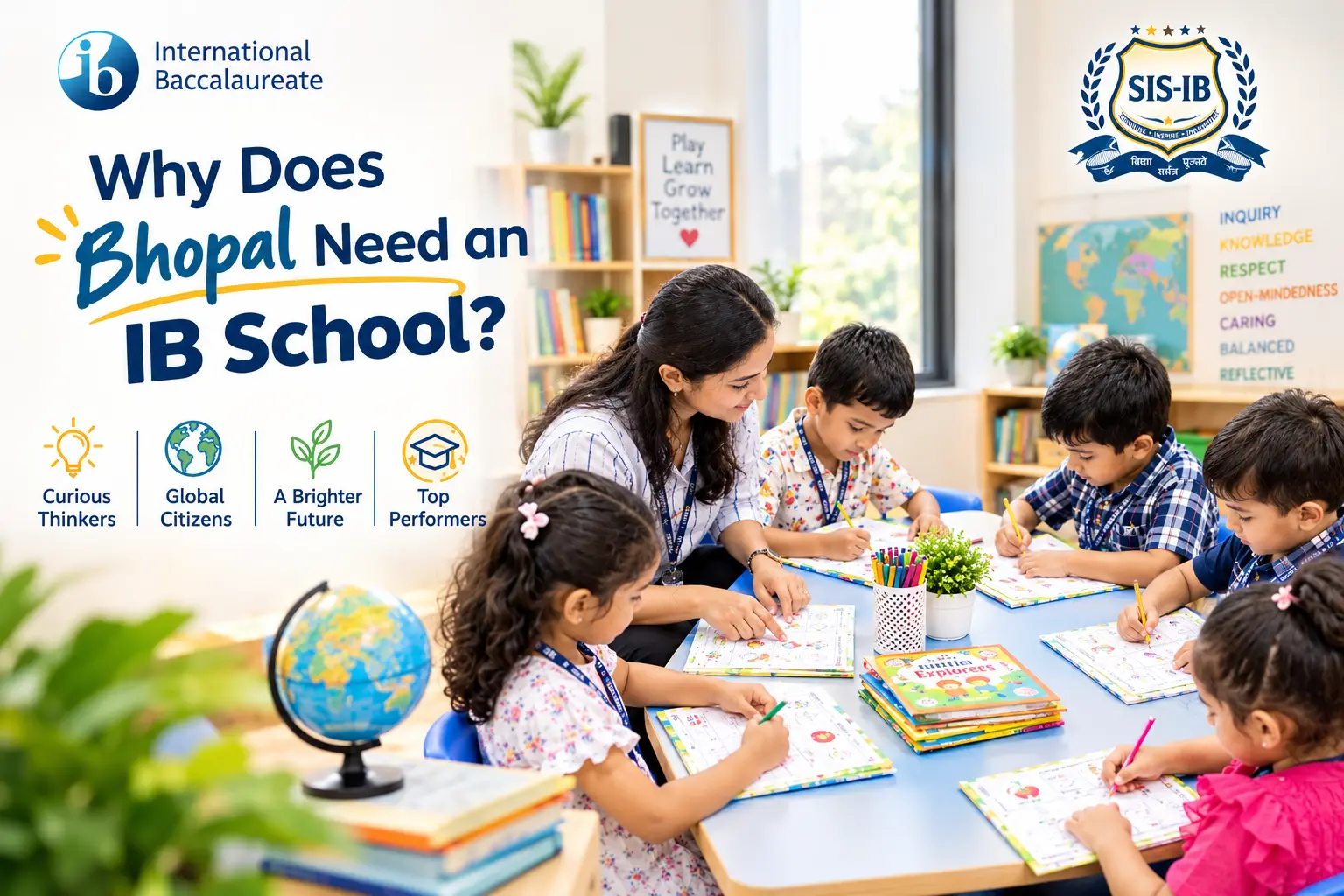
When parents look for a school, the questions often begin quite simply. Will my child read confidently? Will the teacher notice if something is wrong? Will my child enjoy going to school? Then come the questions about the future. Will this education help my child think independently and manage situations we cannot yet imagine?
For families exploring an IB school in Bhopal, these concerns belong together. Strong academics matter, and so does the ability to use learning beyond an examination. Parents deserve to understand what a different approach offers before deciding whether it suits their child.
The International Baccalaureate, or IB, offers educational programmes across different age groups. The Primary Years Programme (PYP), for children aged 3–12, builds learning around inquiry, conceptual understanding and connections across subjects. Other IB programmes serve older learners; a school offering one programme does not automatically offer them all.
In the PYP, six themes provide a framework for exploring meaningful questions: Who We Are; Where We Are in Place and Time; How We Express Ourselves; How the World Works; How We Organize Ourselves; and Sharing the Planet. Children draw on language, mathematics, science, social understanding and the arts to investigate ideas within these themes.
Bhopal already has schools that families value. An IB option adds another way of learning close to home. A family should be able to explore international education while remaining connected to its community, language and everyday life.
Consider a question about Bhopal’s lakes: why should we care about what enters the water? Children could observe their surroundings, read about pollution, collect simple data and write recommendations. Subjects give them tools to understand a shared problem. The work still needs accurate reading, clear sentences and careful calculation.
This matters in what is often called a VUCA world: volatile, uncertain, complex and ambiguous. For a child, that might mean checking conflicting information or adapting when a group plan fails. Learning needs to give children practice in handling such moments.
Student agency is part of that practice. It means voice, choice and ownership. Think of learning to ride a bicycle. An adult supports and guides, but the child must eventually pedal, balance and try again. Similarly, children can help frame questions, choose how to present findings and reflect on mistakes. The teacher plans, teaches and sets boundaries while gradually building independence.
These pathways organise education differently. Good teaching, thoughtful questions and practical learning can exist across all three. This comparison is a starting point, rather than a ranking.
|
What to compare |
IB |
CBSE |
CISCE pathway (ICSE/ISC) |
|
Structure |
Separate programmes for different ages; PYP connects learning across subjects. |
National curriculum with defined subject learning outcomes. |
Council curriculum leading to ICSE and ISC examinations. |
|
Learning approach |
Inquiry, concepts, reflection and application are central to the framework. |
Competency, inquiry and experiential learning feature in curriculum guidance. |
Subject learning includes written work and practical or project components, as applicable. |
|
Assessment |
Depends on programme; PYP uses ongoing assessment of learning. |
School assessment and board examinations at relevant stages. |
School assessment and Council examinations at relevant stages. |
|
Ask the school |
Which programme is offered, and what is its status? |
How are understanding and application taught and assessed? |
How are subjects, projects and workload balanced? |
Choose with your child’s needs, family budget, possible moves and future study plans in mind. No board name can replace a close look at the classroom.
Take these questions along when you visit. Ask for examples, not only assurances.
☐ Does my child seem comfortable asking questions here?
☐ How are reading, handwriting, spelling, grammar and number skills taught?
☐ Can teachers show progress through actual student work?
☐ What support is available when a child needs more time or additional challenge?
☐ What are the full fees, transport costs and likely additional expenses?
☐ What programme status and pathways are confirmed for the coming years?
Check the exact campus, programme and year groups being offered. “International” in a school’s name does not establish IB authorization. Consult the IB’s official school directory for authorized programmes and ask a candidate school for its candidacy documentation. Confirm current admissions, fees and provision directly with the school; online listings can become outdated.
Ask what happens after the highest grade currently offered. A PYP place does not promise an MYP or Diploma Programme place later. Families considering a transfer should discuss learning records, language needs and any bridging support in advance.
There is no single right school for every child. A quieter child can develop agency without being pushed to perform constantly. A child who needs structure should still receive clear routines, explicit teaching and manageable steps. Inquiry requires guidance; children should not be left to work everything out alone.
The practical fit matters too. Fees, travel time and the support a school can actually provide deserve honest discussion. Families should feel free to ask difficult questions and take time over the decision.
The future of international education in India should be judged by what children gain from it. Can they evaluate information, communicate thoughtfully and continue learning when technology changes? Can they understand another perspective while remaining comfortable with their own identity?
For Bhopal, this can mean connecting local experiences with wider questions. A discussion about a family tradition can lead to respectful comparisons across cultures. International mindedness can begin with listening carefully to someone in the same classroom.
SAGE International School at Danish Kunj, Kolar Road, is a candidate school for the Primary Years Programme and is pursuing authorization. Candidate status is a stage in the IB authorization process; it does not guarantee that authorization will be granted.
For parents exploring this option, a campus conversation can make the approach clearer. Ask how inquiry connects with foundational skills, how teachers support student agency and how progress is shared with families. Seeing children’s work can be more useful than hearing educational terms explained in isolation.
It gives families an additional educational choice, with a framework that connects knowledge, inquiry and responsibility for learning within their own city.
There is no independently established “best” school for every child. Compare programme status, teaching, support, affordability and your child’s comfort before choosing.
IB offers international programme frameworks, while CBSE provides a national curriculum and examination pathway. Both can develop understanding; implementation varies between schools.
The IB Diploma is recognised as a university entry qualification in India. Admission still depends on each institution’s subject, score, entrance test and other eligibility requirements. PYP itself is not a college entry qualification.
The school has entered the formal candidacy stage and is working towards authorization for a particular programme. It is not yet authorized for that programme.
The PYP serves ages 3–12. A child may begin from age three where provision is available; school entry ages and placement requirements should be confirmed directly.
Choosing a school is a decision about a child’s everyday experience. We want children to build sound knowledge, ask for help and become increasingly confident in their own thinking. If you are exploring the PYP at SAGE International School, Danish Kunj, arrange a campus visit. Bring your questions, look at the learning and discuss what your child needs. That is a useful place to begin.